
Hemeralopia (night blindness): causes, symptoms, and treatment
When the outlines of objects become blurry after sunset and your eyes take a long time to adjust to the dim light, it's often hemeralopia. Below, we discuss why night vision weakens, the underlying causes, and how an ophthalmologist can identify the source of the problem.

specialists

equipment

treatment






The main causes of hemeralopia

Weakening evening vision has several causes, and they vary in nature. Some are related to nutrition, others to the condition of the eye itself. Let's look at the main causes of hemeralopia to understand the origins of the problem.
Vitamin A Deficiency and Poor Nutrition
Vitamin A deficiency is one of the most common and treatable causes. This vitamin is necessary for the formation of visual pigment, and without it, the retinal rod cells function poorly. Deficiency develops with a poor diet, intestinal diseases, and impaired fat absorption.
Retinol can be obtained from liver, eggs, and dairy products, while its precursor can be found in carrots, pumpkin, and leafy greens. However, if a deficiency has already developed, nutrition alone is sometimes insufficient, and a doctor determines the dosage.
Ingesting large doses without supervision is dangerous, so self-prescribing vitamins is not recommended.

Retinal Diseases
The second major group of causes are retinal diseases, which affect the light-sensitive cells themselves. These include retinitis pigmentosa, a hereditary retinal disorder in which the rods gradually die. In this case, evening vision weakens slowly, year after year.
This also includes dystrophic changes and peripheral vision impairment, when the lateral parts of the visual field are lost. Such conditions are not treated with vitamins, and an ophthalmologist determines the appropriate treatment after an examination. The earlier the disease is detected, the greater the chance of slowing its progression.
Optic Nerve Pathologies and Other Factors
Decreased vision in the dark can also be associated with the optic nerve, which transmits signals from the eye to the brain. When it becomes inflamed or compressed, image transmission is impaired, especially in low-light conditions. High myopia, glaucoma, and previous trauma play a role.
How does hemeralopia manifest itself?
The symptoms develop gradually, and people don't always immediately associate them with their eyes. Initially, a slight hesitation appears in the evening, then it intensifies. It's important to recognize these changes early.
First Signs of Deteriorating Twilight Vision
Several daily situations can help you suspect a problem. If you recognize yourself in any of these, it's worth checking your twilight vision:
- Difficulty navigating in twilight
- Adjusting to darkness takes longer
- Vision becomes worse immediately after exposure to bright light
- Walking unsteadily in the evening
- Reading or driving in low light has become difficult
These signs indicate that adaptation to darkness has slowed. Individually, each of them can be attributed to fatigue, but together they form a characteristic pattern.
At this stage, examination is simpler, and the cause is often reversible.
When symptoms become alarming
Certain symptoms require a quick visit to the doctor rather than a scheduled appointment. A sharp decline in evening vision over a short period of time is considered alarming. Flashes of light, floating spots before the eyes, and a narrowing of the visual field should also be alarming.
The dangers of late treatment
When a person waits too long to see a doctor, the underlying cause continues to persist. In retinal disease, cell death becomes irreversible during this time.
General information
How do we diagnose the cause of decreased vision in the dark?
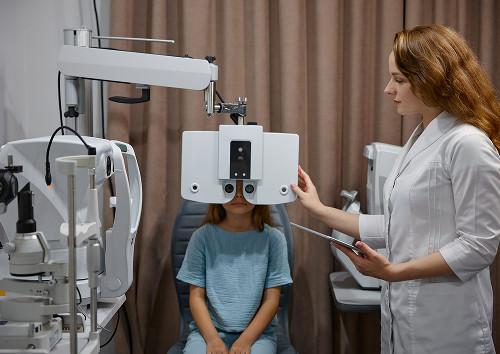
Diagnosing hemeralopia is aimed at finding the cause. First, the doctor collects a history of the patient's complaints, then performs an eye examination with instruments. This procedure helps to understand the cause of the decreased vision in the dark.
Ophthalmologist examination and collection of complaints
The appointment begins with a conversation. The ophthalmologist clarifies when the difficulty with evening vision began, how it changes, and whether there are any associated medical conditions. Diet and previous intestinal surgeries, which affect vitamin absorption, are also important.
Visual acuity and dark adaptation testing
Next, visual acuity is measured with and without correction. The eye's adaptation speed to low light is also assessed. This test shows whether dark adaptation is normal or significantly delayed.
Fundus examination and additional tests
A key step is a fundus examination, during which the doctor visualizes the retina and optic nerve. Changes in the retina indicate the presence of retinitis pigmentosa, retinal dystrophy, or vascular disease. If necessary, optical coherence tomography and visual field testing are performed.



Frequently Asked Questions
Are hemeralopia and night blindness the same thing?
Can hemeralopia be treated with vitamins?
When should I urgently seek medical attention?
How is hemeralopia diagnosed?
Our doctors





















This award is given to clinics with the highest ratings according to user ratings, a large number of requests from this site, and in the absence of critical violations.

This award is given to clinics with the highest ratings according to user ratings. It means that the place is known, loved, and definitely worth visiting.

The ProDoctors portal collected 500 thousand reviews, compiled a rating of doctors based on them and awarded the best. We are proud that our doctors are among those awarded.
Make an appointment at a convenient time on the nearest date
Price
Other services

Appointment to the doctor
Reviews














Our clinics


Application “Personal Account K+31”












What is hemeralopia and why shouldn't it be ignored?
Hemeralopia is a decreased ability to see in low light, twilight, and darkness. During the day, a person sees normally, but as evening approaches, they lose spatial awareness. This symptom often masks either a deficiency of certain nutrients or an eye disease, which is important to recognize early.
Hemeralopia and Night Blindness: The Same Thing or Not?
There is no difference between the terms. Night blindness is a common name for the same condition, while hemeralopia is its medical term. Sometimes a third variant, night blindness, is encountered, which describes the same problem with vision in the dark.
Why does vision deteriorate at dusk?
Special cells in the retina, called rods, are responsible for vision in low light. They capture minimal amounts of light and help us distinguish objects in the evening. Their function requires a special pigment, rhodopsin, whose synthesis involves vitamin A.
If the rods are damaged or the pigment is deficient, vision deteriorates in twilight. The eye takes longer to adjust when moving from a lighted to a dark room, and the outlines of objects become blurred. This is how nighttime vision impairment develops, which is what brings a person to the doctor.