
Penile cancer
This is a rare tumor, and due to the sensitivity of the topic, men often seek treatment late. Penile cancer, or penile cancer, develops slowly and is highly treatable in its early stages, often with organ preservation. The first changes are visible to the naked eye, but they can easily be mistaken for an infection.

specialists

equipment

treatment







Symptoms of penile cancer

The disease rarely occurs secretly. Symptoms of penile cancer are usually noticeable to the man himself, but they are often mistaken for an infection.
Early signs of the disease
At the start, local changes appear: a non-healing ulcer, erosion, compaction or spot on the head or foreskin.
Symptoms in later stages
Later the picture is brighter: tumor growth, bleeding, discharge with an unpleasant odor; the inguinal lymph nodes are enlarged.
When you need to see a doctor “K+31”
Any persistent change in the skin of an organ is a reason for examination. You should make an appointment with an oncologist if you have:
- Non-healing ulcer on the penis
- Seal or assembly
- Skin color change
- Discharge with an unpleasant odor
- Bleeding
- Enlarged inguinal lymph nodes
It is especially important not to wait if the wound does not heal for more than two to three weeks.
Causes and risk factors
It's difficult to pinpoint the exact cause, but key factors are known and help ensure timely examination.
Human papillomavirus (HPV)
Infection plays a major role. HPV is detected in a significant proportion of cases, so the link between HPV and penile cancer is considered proven.
Chronic inflammatory processes
Long-term irritation also plays a role: chronic balanitis, phimosis, and poor hygiene promote inflammation, which increases the risk.
Other risk factors
Additionally, smoking, age, untreated phimosis, and decreased immunity are significant factors.
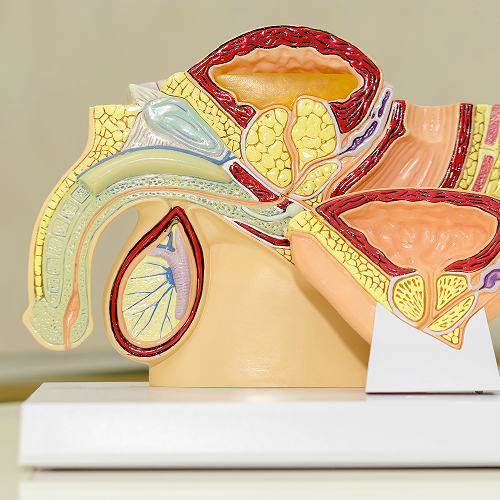
Stages of penile cancer
The stage is determined by the depth of tumor invasion in the penis and lymph node involvement. Penile cancer stages are divided into three groups; these determine the extent of treatment and prognosis.
Localized tumor
The tumor is limited to superficial tissues. This is the most favorable option, often allowing organ preservation.
Regional spread
Tumor cells have reached the inguinal lymph nodes. In this case, their removal and additional therapy are added to treatment.
Disseminated tumor process
The tumor has grown deeper or has caused distant metastases, which require systemic drug treatment.
Diagnosis of penile cancer
An examination confirms the diagnosis and determines the stage. Diagnosis of penile cancer is based on examination, biopsy, and imaging and usually follows these steps:
- Examination and consultation with a specialist
- Biopsy of the affected area
- Ultrasound of the groin and radiation methods
- Determining the stage of the disease
Without tissue examination, the diagnosis is not considered confirmed.
Specialist examination and consultation
They begin with an examination. This includes an assessment of the tumor, inguinal lymph nodes, and the patient's general condition.
Biopsy and morphological examination
The diagnosis is confirmed by tissue analysis. A penile biopsy with histological examination accurately determines the tumor type.
Instrumental diagnostics
To assess the spread of the tumor, ultrasound is used, and if necessary, CT or MRI; these methods show the condition of the lymph nodes and the depth of invasion.
Determining the stage of the disease
The examination results in the precise stage of the disease, which determines the choice of surgery.
Our specialists especially value early consultation.
"In our practice, early diagnosis of penile cancer is crucial. In the early stages, organ-preserving treatments are often successful, maintaining the patient's quality of life. To determine the optimal approach, we consider each case individually and involve specialists from various fields."
Modern treatment methods
| Method | When used | Advantages | Limitations |
|---|---|---|---|
| Organ-preserving treatment | Early superficial tumors | Preservation of anatomy and function | Not suitable for deep invasion |
| Surgical treatment | Localized and locally advanced forms | Radical tumor removal | Functional and cosmetic consequences |
| Radiation therapy | Early stages, refusal of surgery | Organ preservation | Radiation reactions, risk of recurrence |
| Drug therapy | Advanced disease, metastases | Systemic effects | Side effects, requires monitoring |
Surgical treatment
Surgery remains the primary treatment option. Surgical treatment involves removing the penile tumor within the healthy tissue.
Organ-preserving surgeries
Whenever possible, the organ is preserved: organ-preserving surgeries remove only the tumor and are suitable for early stages.
Radiation therapy
Radiation therapy is an alternative to surgery in the early stages. Radiation therapy allows for organ preservation, but requires monitoring due to the risk of recurrence.
Drug-based antitumor therapy
For advanced disease, medications are used. Antitumor therapy—chemotherapy, sometimes immunotherapy—affects the tumor systemically.
General information
How is treatment performed?
Penile cancer treatment is structured so that decisions are made thoughtfully and in consultation with your doctor.
Initial consultation
It all starts with an appointment. The oncologist's consultation includes an examination, biopsy review, and a discussion of options.
Developing a personalized plan
The treatment plan is determined by a consultation. The plan takes into account the stage, tumor type, age, and the patient's desire to preserve the organ.
Results monitoring
During treatment, the doctor evaluates the tumor's response and adjusts the plan if necessary.



Answers to frequently asked questions
What symptoms may indicate penile cancer?
Can penile cancer be cured?
What diagnostic methods are used?
Is surgery always necessary?
Penile cancer is curable, especially when caught early; modern cancer treatments often allow the organ to be preserved. Don't put off a visit out of embarrassment; delaying it reduces your chances. If you notice any signs of penile cancer, schedule a consultation with an oncologist.
Clinical Guidelines of the Ministry of Health of the Russian Federation. Penile Cancer — https://cr.minzdrav.gov.ru/
Category of Clinical Guidelines of the Ministry of Health of the Russian Federation — https://cr.minzdrav.gov.ru/
Russian Society of Clinical Oncology (RUSSCO) — https://rosoncoweb.ru
Russian Society of Urologists — ttps://uroweb.ru
eLIBRARY Scientific Electronic Library — https://elibrary.ru
CyberLeninka — https://cyberleninka.ru
MSD Manual (Russian version) — https://www.msdmanuals.com/ru
National Medical Research Center of Oncology of the Ministry of Health of Russia — https://www.oncology.ru
National Medical Research Center of Radiology of the Russian Ministry of Health — https://nmicr.ru
N.N. Blokhin National Medical Research Center of Oncology of the Russian Ministry of Health — https://www.ronc.ru
Our doctors
















































This award is given to clinics with the highest ratings according to user ratings, a large number of requests from this site, and in the absence of critical violations.

This award is given to clinics with the highest ratings according to user ratings. It means that the place is known, loved, and definitely worth visiting.

The ProDoctors portal collected 500 thousand reviews, compiled a rating of doctors based on them and awarded the best. We are proud that our doctors are among those awarded.
Make an appointment at a convenient time on the nearest date
Price
Other cancer treatment services

Appointment to the doctor
Reviews





















Our clinics


Application “Personal Account K+31”











