
Urinary Incontinence Sling Surgeries
Urinary incontinence is a problem that doesn't discriminate between genders. Both women and men face it, but few talk about it. Shame, embarrassment, and the attitude that "it's just part of getting older" or "it happens after surgery" force millions of people to endure it silently, limiting their most important thing—their freedom—for years. It's important to understand: incontinence isn't a death sentence or a punishment for aging, childbirth, or previous surgeries. It's a condition that can be successfully treated. And today, there's a method that restores full control in 95% of cases: sling surgery.

specialists

equipment

treatment







How do you know if a problem requires attention?
Urinary incontinence comes in different forms, and it's important to recognize its symptoms early—for both women and men.
Symptoms in Women
Stress Incontinence (most common in women):
- Do you leak urine when coughing, sneezing, or laughing?
- Do you experience discomfort while exercising: running, jumping, or doing fitness classes?
- Do you have trouble lifting heavy objects (grocery bags, holding a child)?
- Are there any "surprises" during sexual intercourse?
Urgent Incontinence (Overactive Bladder):
- Do you experience a sudden, very strong urge to urinate that you can't Can you hold it in?
- Do you manage to get to the bathroom in time, or do you have "accidents"?
- Do you have to wake up to go to the bathroom two or more times a night?

Symptoms in Men
Incontinence after Surgery:
- Did this problem occur after prostate surgery (especially after prostate adenoma removal or for prostate cancer)?
- Do you notice leakage during physical activity, coughing, or sneezing?
- Do you need to constantly use pads or urinary inserts?
Urgent Incontinence:
- Do you experience sudden, difficult-to-control urges?
- Do you experience incontinence at night?
- Is the problem accompanied by frequent urination?
Important: Even one positive answer is a reason to consult a specialist. This is not a "body feature," but a symptom that indicates that the pelvic floor muscles, ligaments, or sphincter are not working as they should.


95% The effectiveness of sling procedures (TVT and TVT-O) in treating stress urinary incontinence is one of the highest in medicine.

20–30 minutes Duration of surgery. This is not a multi-hour abdominal surgery, but a precise, minimally invasive procedure with a short recovery period.

24 hours The maximum hospital stay. You return home almost immediately to a comfortable and familiar environment.

10+ years The minimum period for lasting results. A decade without worries, restrictions, or daily reassurance.
Who is suitable for sling surgery?
Women with:
- Stress incontinence of any degree
- Mixed incontinence with a predominant stress component
- Incontinence after childbirth or gynecological surgery
Men with:
- Incontinence after radical prostatectomy (removal of the prostate gland)
- Incontinence after transurethral surgery for prostate adenoma (enucleation or resection)
- Mild to moderate incontinence (sphincter implantation is considered for more severe forms)
Contraindications are minimal, and the risk of complications with proper patient selection approaches zero.

Treatment Stages at K+31
Step 1. Accurate Diagnosis
Before recommending surgery, we conduct a comprehensive examination:
- Pad Test or (PAD-Test) - a method for detecting urinary incontinence and determining its severity
- Urodynamic study (UDT) - to accurately determine the type of incontinence
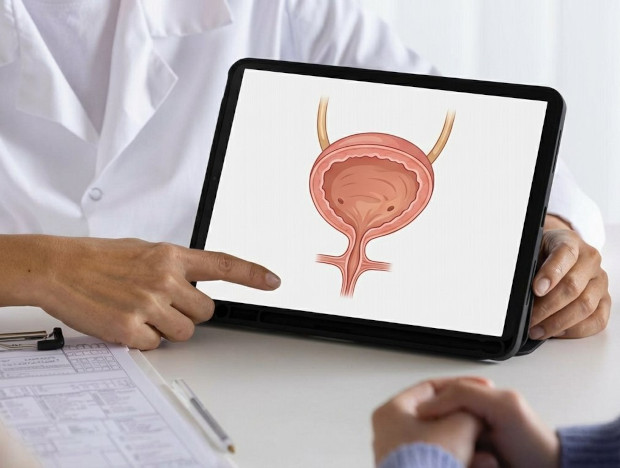
- Fibrocystoscopy - examination of the urethra and bladder from the inside
- Ultrasound - assessment of the anatomy and function of the pelvic organs
This ensures that the sling surgery Find the right procedure for you and choose the optimal technique.
Step 2. Surgery - 20 minutes under expert supervision
The procedure is performed under spinal or intravenous anesthesia. The surgeon inserts the loop through two small punctures (in the groin or through the obturator foramen). The position is monitored with a cystoscope, allowing the doctor to see every step.
Step 3. Returning home - tomorrow
After surgery, you spend just one day in the hospital under the supervision of medical staff. The next day, you go home with clear recovery recommendations.
Step 4. Rehabilitation and follow-up
A follow-up examination is scheduled after one month, and a final evaluation of the results is scheduled after six months. Most patients forget about the problem forever and return to a full life, including sports and physical activity.

Our doctors








This award is given to clinics with the highest ratings according to user ratings, a large number of requests from this site, and in the absence of critical violations.

This award is given to clinics with the highest ratings according to user ratings. It means that the place is known, loved, and definitely worth visiting.

The ProDoctors portal collected 500 thousand reviews, compiled a rating of doctors based on them and awarded the best. We are proud that our doctors are among those awarded.
Make an appointment at a convenient time on the nearest date
Price
Other services

Appointment to the doctor
Reviews





















Our clinics


Application “Personal Account K+31”












Sling surgeries: what are they and why do they work?
Sling procedures (TVT and TVT-O) are the global gold standard for the treatment of stress urinary incontinence. This method has been used for over 20 years, and during this time, it has proven its safety and high effectiveness.
How it works:
For women, a special synthetic loop—a sling—is inserted under the middle part of the urethra through small punctures (literally pinpoint accesses). It provides reliable support and acts like a "hammock," holding the urethra in the correct position during physical activity, coughing, or laughing. At rest, the loop does not cause any discomfort and does not interfere with natural urination.
Similar solutions exist for men—male slings—which are especially effective for mild incontinence after prostate removal. In more complex cases, implantation of an artificial urinary sphincter is used, but even here, sling techniques remain the preferred choice when appropriate.