
Treatment of Initial Caries
Many people think of tooth decay as a painful hole in the tooth. This is partly true, but pain is a symptom of the final stage.
Initial caries is a tooth decay in which changes affect only the enamel structure, without destroying its integrity. If treatment is started early, the tooth can be cured without drilling or filling.

specialists

equipment

treatment






Signs of initial caries

Recognizing the signs of early caries on your own is difficult, as the changes are often localized in hard-to-reach areas—on the contact surfaces of the teeth or in the neck area. However, there are a number of symptoms that indicate demineralization.
White, chalky, and pigmented spots
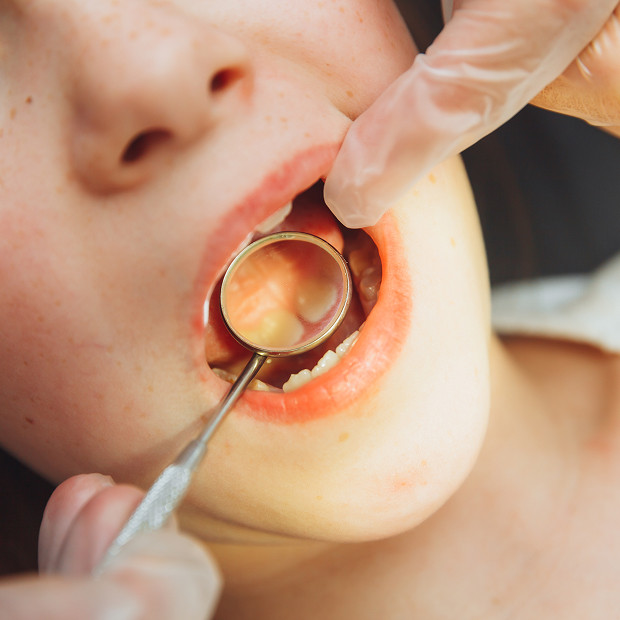
The first visual signal is the white spot stage. The affected area differs from the healthy one only in color: it is more matte. A white spot on a tooth is the main symptom of mineral loss. Over time, if the process is not stopped, the spot may change color to yellowish or brown. This occurs due to the penetration of food coloring and bacterial waste products into the porous structure.
Enamel Sensitivity and Roughness
As demineralization progresses, the patient may notice that the enamel has lost its usual smoothness. The tongue may feel a rough surface. Short-term tooth sensitivity often occurs when exposed to chemical irritants (sour, sweet) or temperature factors (cold air, water).
Can initial caries be painless?
Initial caries is painless. Since the dentinal tubules, which are connected to the nerve endings, are still protected by a layer of enamel, the typical toothache is absent. It is the asymptomatic progression that makes regular professional diagnostics essential.
Signs of early caries that require a dental examination:
- White spot on the tooth
- Darkening of an area of enamel
- Surface roughness
- Sensitivity to sweet, cold, or sour foods
- Frequent plaque accumulation in one area
- Recurrence of the stain after whitening products
Treatment methods for initial caries
Remineralizing therapy
This is a conservative treatment for early caries, aimed at remineralizing the enamel. The dentist applies preparations containing concentrated calcium, phosphates, and fluoride to the teeth. This method is effective only if the tooth's protein matrix is preserved. Reversibility is only possible at this stage and with strict adherence to the dentist's recommendations.
Enamel Infiltration
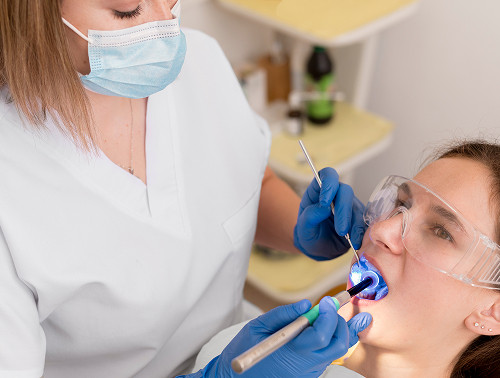
The Icon method treats cavities without drilling. The dentist treats the stain with a special gel that opens the pores and then fills them with a flowable polymer. The gel hardens under a lamp, sealing the lesion and stopping bacterial growth.
When might a filling be needed?
If diagnostics show that demineralization has progressed to the stage of superficial caries with the formation of a microcavity, enamel remineralization will not help. In this case, the tooth will need to be filled.
Comparison of Initial Caries Treatment Methods
| Method | When used | Is anesthesia necessary? | Is drilling required? | Main objective | Limitations |
|---|---|---|---|---|---|
| Remineralization | White spot stage | No | No | Enamel mineralization | Course Duration |
| Infiltration | Initial Caries | Usually No | No | Pore Closure with Polymer | Ineffective for Cavities |
| Filling | Superficial Caries | Yes | Yes | Tissue Restoration | Removal of Partial Tissue |
General information
Causes
The development of dental caries is the result of an imbalance between demineralization and remineralization processes in the oral cavity.
Dental Plaque, Bacteria, and Acids
Cavities are caused by bacteria of the mutans group (Streptococcus mutans). They digest carbohydrate residues from food and produce acid that destroys enamel. The longer the acid is in contact with the tooth, the less likely it is to treat caries without drilling.
Poor Oral Hygiene
Soft plaque is an ideal breeding ground for bacteria. If you brush your teeth poorly or not on schedule (twice a day, morning and evening), plaque will turn into tartar, under which the decay process is most active.
Diet, mineral deficiencies, and other risk factors
A diet high in sugar and simple carbohydrates creates a persistently acidic environment. Mineral metabolism in the body also affects dental health. A deficiency of elements such as fluoride, calcium, and phosphorus in drinking water or food reduces enamel's resistance to acids.


Frequently Asked Questions
Important: If a stain appears on a tooth, sensitivity increases, or the surface becomes rough, do not attempt to remove it yourself. Visit your dentist to rule out more serious forms of decay.
Can early decay be treated at home?
Does a spot on a tooth always indicate decay?
Is treating decay at the spot stage painful?
Our doctors

















































This award is given to clinics with the highest ratings according to user ratings, a large number of requests from this site, and in the absence of critical violations.

This award is given to clinics with the highest ratings according to user ratings. It means that the place is known, loved, and definitely worth visiting.

The ProDoctors portal collected 500 thousand reviews, compiled a rating of doctors based on them and awarded the best. We are proud that our doctors are among those awarded.
Make an appointment at a convenient time on the nearest date
Price

Appointment to the doctor
Reviews





















Our clinics


Application “Personal Account K+31”












What is incipient caries?
Incipient caries is a process of enamel demineralization. Under the influence of certain factors, minerals (calcium and phosphates) begin to leach out of the hard tissues of the tooth. This causes the enamel to become porous and lose its shine and density.
Spot-stage caries: what happens to enamel
Spot-stage caries is a specific condition in which the tooth surface changes externally, but the anatomical shape is preserved. Due to the active leaching of minerals, the enamel crystal lattice weakens.
Micropores form in the subsurface layer. These pores alter the optical properties of the tooth: the affected area begins to reflect light differently, causing a characteristic spot to appear on the enamel. At this stage, the carious process has not yet affected the dentin, so treatment of incipient caries may be limited to conservative methods.
How does the initial stage differ from superficial caries?
The main difference is the presence of a tissue defect. In the initial stage, the enamel surface remains smooth (although slight roughness may appear), and the integrity of the tooth is intact. While enamel remineralization is still possible at the stain stage, superficial lesions often require infiltration or minimal preparation.